Qwen3.8-27B Ranks Ninth in Code Arena WebDev: Strengths and Practical Limits
Audience:
Developers comparing open-weight models for local coding
Key Points
- Qwen3.8-27B is Alibaba's 27B dense model with an Apache 2.0 license, a 262,144-token native context, and image and video input.43
- It ranked ninth overall in the August 21, 2026 Code Arena WebDev snapshot. That leaderboard measures human preference for web output, not long-running agent completion.
- A practical 4-bit file is about 17 GB. The model is approachable for local testing, but promotion should depend on repeated success rate and elapsed-time measurements.
Adoption Boundary Up Front
What the evidence shows—and what it does not
Available comparisons: Web-generation preference rank, five Qwen-reported benchmarks, model size, and license.
Still unmeasured independently: Repeated long-running agent reliability and performance on the new Mac mini.
The practical position is shortlist for web generation and supervised coding, test candidate for unattended long-running work. Do not promote it on rank alone; use repeated tasks with fixed completion criteria.16
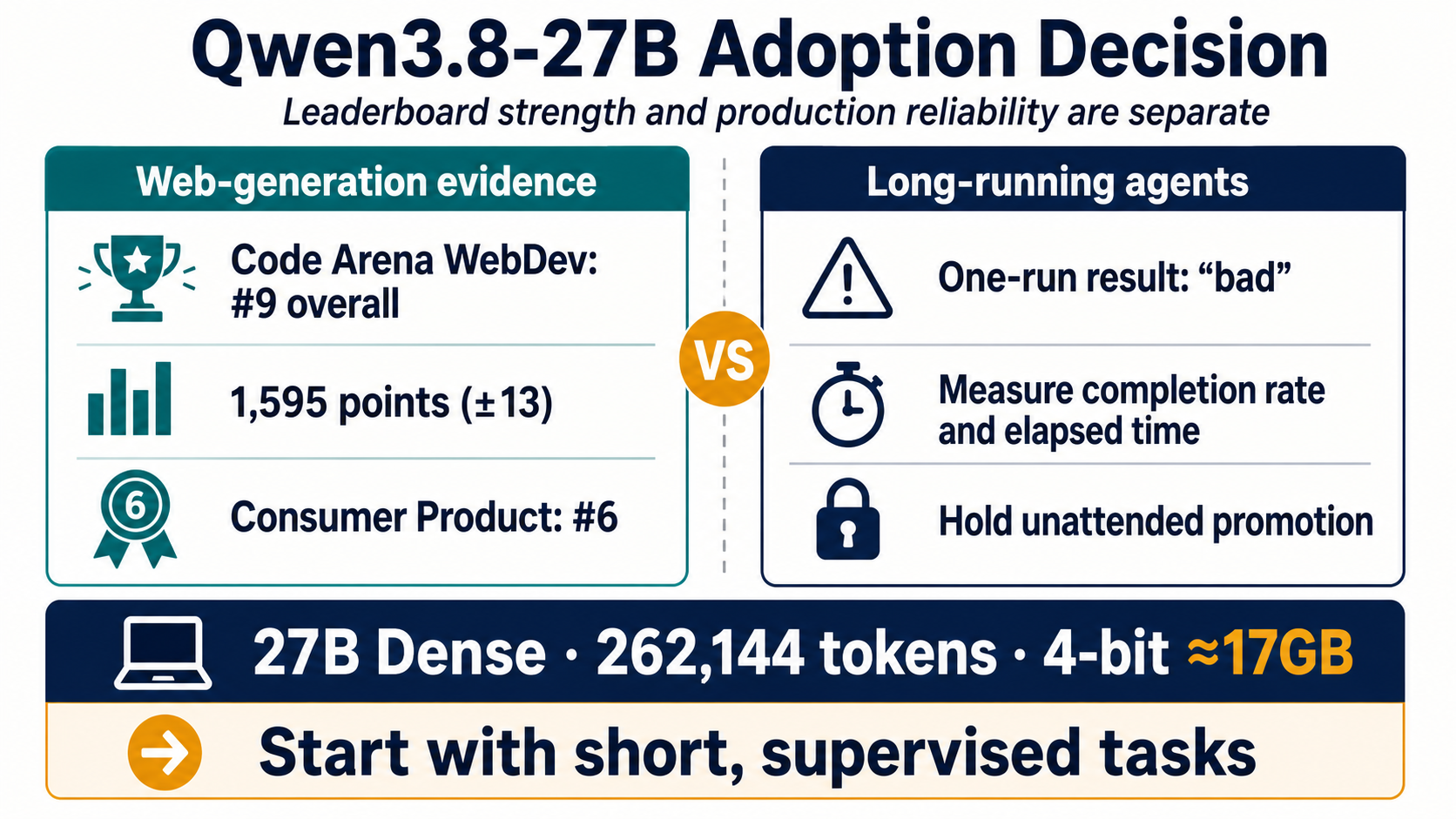
Ninth Place in Web Generation
Code Arena WebDev compares front-end development output through human preference votes, including tasks with multi-step reasoning and tool use. The August 21 snapshot reports the following results.12
| Board | Rank | Score | Rank range |
|---|---|---|---|
| Overall | 9 | 1,595 ±13 | 8–13 |
| Consumer Product | 6 | 1,587 ±32 | 2–15 |
| Brand & Marketing | 7 | 1,627 ±24 | 3–12 |
| Gaming | 8 | 1,645 ±26 | 6–13 |
The ±13 notation is the uncertainty displayed with the score; the rank range is the leaderboard's estimated placement range under that uncertainty. Ninth overall establishes a place in the leading group, while the broad domain ranges do not establish permanent category leadership.
Ninth Place Does Not Set Agent Reliability
Code Arena WebDev uses human preference voting on front-end development tasks. The tasks include multi-step reasoning and tool use, but the leaderboard does not directly measure repository exploration, test repair, recovery from mistakes, or total task time.1
A public one-run experiment ported roughly 600,000 tokens of C into a single HTML file. The report attaches the labels hermes and codehamr to the two Qwen runs but does not define the tools themselves.6
| Configuration | Elapsed time | Author rating |
|---|---|---|
| Claude Code + Opus 5 | 21 minutes | okay |
| Qwen3.8-27B + hermes | 4 hours 18 minutes | bad |
| Qwen3.8-27B + codehamr | 1 hour 40 minutes | bad |
The Qwen runs used an RTX 6000 Pro 96GB, vLLM, FP8 weights, an FP8 KV cache, and the full 262,144-token context. There was one run per configuration, no follow-up prompt, and the source exceeded the context window. The result mixes model, prompt, and harness effects, making a separate adoption test necessary for long-running work.
Official Benchmarks in One Table
The Qwen model card reports a split result against Claude Opus 4.6 Max.3
| Benchmark | Qwen3.8-27B | Opus 4.6 Max | Higher model |
|---|---|---|---|
| SWE-bench Pro | 61.7 | 53.4 | Qwen |
| LiveCodeBench v6 | 90.3 | 88.8 | Qwen |
| Terminal-Bench 2.1 | 73.0 | 78.2 | Opus |
| GPQA Diamond | 89.2 | 91.3 | Opus |
| Humanity's Last Exam | 30.8 | 40.0 | Opus |
The comparison is not fully harmonized. For SWE-bench Pro, the Opus value is its officially reported result, while Qwen evaluated the other models with a Claude Code harness. Artificial Analysis provides a separate view for the 4B-40B small open-weight class. Its nine-evaluation Intelligence Index gives Qwen3.8-27B at xhigh a score of 52, but that score alone does not establish long-running agent reliability. The page also describes provider-measured output speed as below the comparable-class median and token generation as unusually verbose; that provider speed is not a local-hardware measurement.5
An adoption test therefore needs both task success and the elapsed time, retries, and output required to finish.
Memory Required for Local Execution
Qwen3.8-27B is a 64-layer dense model combining 48 Gated DeltaNet layers with 16 Gated Attention layers. It supports a native 262,144-token context, image and video input, adjustable Thinking, and an Apache 2.0 license.3
| Precision or format | Approximate weights | Capacity starting point |
|---|---|---|
| BF16 | about 54 GB | Verify runtime headroom even on a 64 GB-class system |
| FP8 | about 27 GB | 32 GB leaves little margin; 64 GB is more practical |
| 4-bit quantized | about 17 GB file | 24 GB suits short tests; start at 32 GB for practical runtime headroom |
Runtime memory adds the operating system, inference engine, KV cache, and concurrent work. Here, MTP (Multi-Token Prediction) refers to the report's draft-mtp speculative-decoding setting.7 Qwen enables Thinking by default and sets reasoning_effort to xhigh, so simple workloads should also measure reasoning overhead.3 Qwen notes that lowering reasoning effort may increase failures and retries, so total time in multi-turn work does not always fall.3
In Willison's environment, this MTP setup was about 72% faster than the default LM Studio GGUF setup. The result is specific to that setup, so runtime configuration belongs in the test record.7
Pairing It with the New Mac mini
Apple announced the new Mac mini on August 25: M6 configurations list 16 GB, 24 GB, and 32 GB, while M5 Pro supports up to 64 GB.89 The roughly 17 GB 4-bit build makes 32 GB the M6 starting point; the roughly 27 GB FP8 estimate points toward a 64 GB M5 Pro configuration. For pricing and configuration choices, see the Gadgets guide, The New Mac mini Starts at ¥149,800.10
Four Measurements Before Adoption
Qwen3.8-27B fits best when code must remain local, fixed hardware cost is acceptable, and evaluation can start with short web-generation or supervised coding tasks. If unattended completion, tight deadlines, and low retry rates are requirements, do not switch the default based on the Arena rank alone.
Run the same representative task more than once and record four items:
- Completion criteria and tests fixed before execution
- Model, quantization, context, Thinking level, and harness
- Success rate, elapsed time, retries, and GPU time
- The cloud-model difference and cost per completed task
The Code Arena result is a reason to test Qwen3.8-27B. The promotion gate is an acceptable completion rate and total elapsed time on the target repository.
Related Articles
Sources
Arena, Code Arena WebDev Overall Leaderboard (accessed August 26, 2026). The August 21 board supplies rank, score, rank spread, votes, and task framing. ↩↩↩
Arena, Consumer Product, Brand & Marketing, and Gaming (accessed August 26, 2026). ↩
Qwen, Qwen3.8-27B Model Card (accessed August 26, 2026). Architecture, context, license, Thinking controls, official benchmarks, and harness notes. ↩↩↩↩↩
Qwen Team, Alibaba Group, Qwen3 concepts (accessed August 26, 2026). Project attribution and open-weight model family. ↩
Artificial Analysis, Qwen3.8 27B (xhigh) (accessed August 26, 2026). Intelligence Index v4.1.1, speed, output-token use, and comparison class. ↩
Reddit r/LocalLLaMA, New qwen3.8:27b on a 39k line C to single-file HTML / three.js port (accessed August 26, 2026). This is one author's one-run experiment, not a general benchmark. ↩↩
Simon Willison, Qwen 3.8 27B is excellent, but it defaults to wildly overthinking things (accessed August 26, 2026). Approximate 4-bit file size and a configuration-specific MTP comparison. ↩↩
Apple Japan, Buy Mac mini (accessed August 26, 2026). Current M6 configurations with 16 GB, 24 GB, and 32 GB unified memory. ↩
Apple Newsroom, Apple unveils a more powerful Mac mini featuring the all-new M6 and M5 Pro (August 25, 2026). M5 Pro support for up to 64 GB unified memory. ↩
SmartScope Gadgets, The New Mac mini Starts at ¥149,800 (August 26, 2026). Configuration comparison and the pre-release test boundary. ↩